“How many loaves do you have?” Mark 8:5
It wasn’t really a question, but a response to a question. “Where in this remote place can anyone get enough bread to feed them?”
“Then the Lord said to him, “What is that in your hand?”
“A staff.” he replied.
The Lord said, “Throw it on the ground.” Ex. 4:2-3
“. . . but first make a small loaf of bread for me from what you have and bring it to me.” 1 Kings 17:13
Our God, who created the universe out of nothing, does not need our “bread” or “staff” in order to accomplish his plans, yet he asks for our contribution. His questions lead us to consider what we have, and then tests our willingness to surrender it, no matter how meager or inadequate it may seem. He gives us the opportunity to be awed by what he can do with it. We are given the privilege of sharing in the wonders of our God!
It reminds me of this picture I took in Philadelphia a few weeks ago. The man was simply doing what he was charged to do. He was unaware of the bigger picture he was a part of. A few feet away, I was nudging Brad and pointing, “Do you see that?” Framed with the supplies he had been given to do his work, and reflected in the results of his work, he was beautiful!
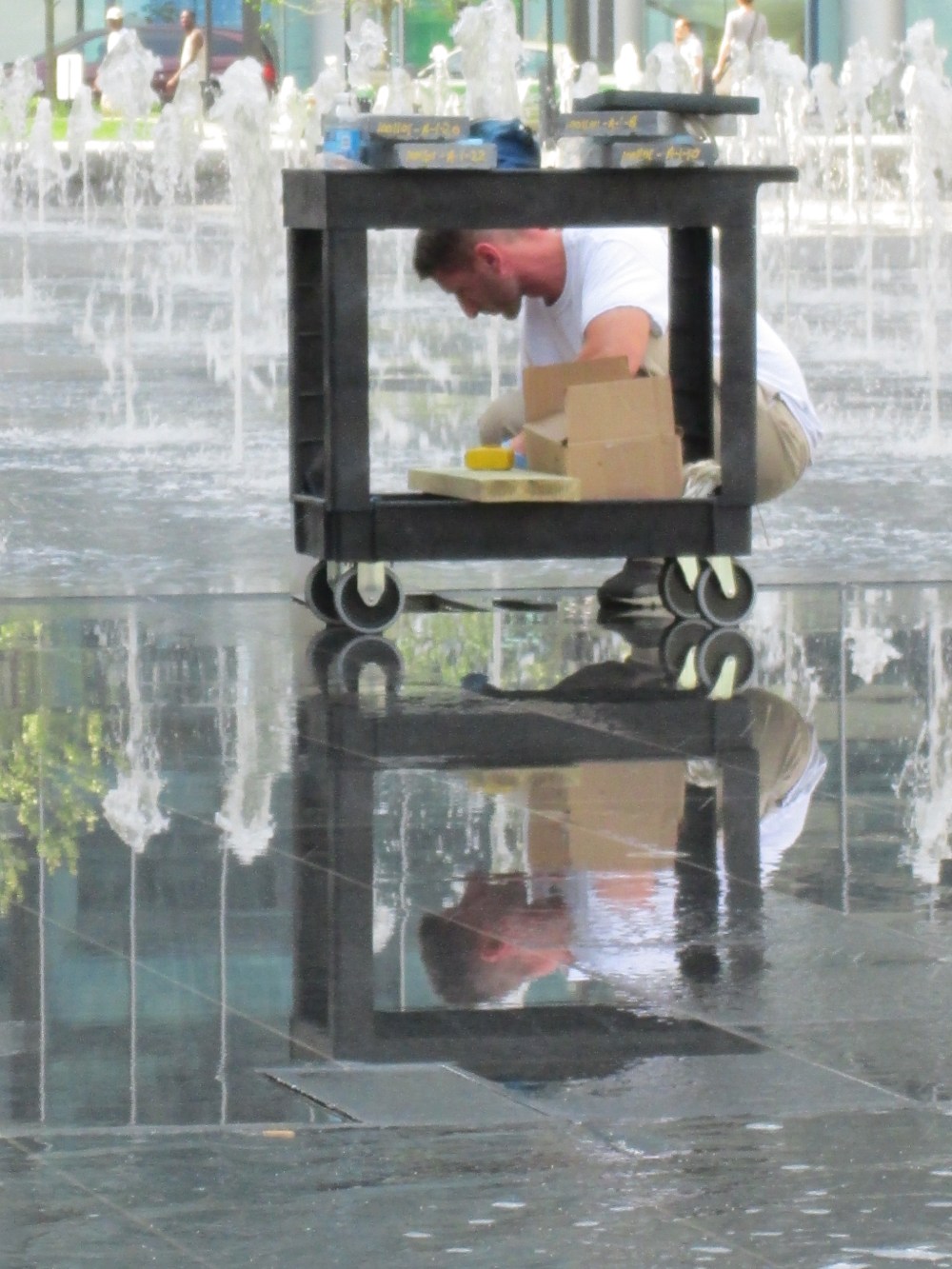
The next time, we feel inadequate or ill-equipped for the need at hand, we need to listen carefully. We might just hear Jesus whisper, “How many loaves do you have?”, or “What’s that in your hand?”, or “Make for me . . . from what you have. . . “.
And if we surrender, and do the work we are charged to do, just maybe . . . somewhere in the heavenly realm, someone may be nudging someone, and saying “Do you see that? She doesn’t even realize what she’s a part of. Isn’t she beautiful?”
PART 2:
“Why are you talking about having no bread?” (Mark 8:17)
What follows is the strongest recorded rebuke that Jesus gives his disciples. Preceding this moment was several days of ministry, countless healings, ending with the feeding of thousands of people with just a few loaves of bread, and a few fish. “The people ate, and were satisfied.” (v.8) But there is always a challenge, always some negativity, and at the next stop, they were confronted with the Pharisees. Jesus refuses to jump through their hoops, and later warns his disciples “Be careful” “Watch out for the yeast of the Pharisees . . ” The disciples, however, were focusing on the fact that on this trip, they had forgotten to bring bread with them. They made a simple mistake, and now they cannot grasp what Jesus is trying to tell them because they can’t see beyond that mistake. Negativity takes root easily, and spreads quickly. If not addressed, it becomes a powerful filter. Jesus said “Be careful”; they heard “you’ve let me down”. Jesus immediately goes to the heart of the matter.
“Why are you talking about having no bread?”
“Do you still not see or understand?
Are your hearts hardened?
Do you have eyes but fail to see, or ears but fail to hear?”
“And don’t you remember?”
“When I broke the five loaves for the five thousand, how many basketfuls of pieces did you pick up?”
“And when I broke the seven loaves for the four thousand, how many basketfuls of pieces did you pick up?”
“Do you still not understand?”
When Jesus asks questions, it is because he wants us to examine our thinking, not because he doesn’t know the answer himself. Here, he hits his disciples with several questions, but they all lead back to the first:
“Why are you talking about having no bread?”
–This is a follow-up to the earlier question:
“How many loaves do you have?”
It is a reminder not to focus on our insufficiency, but on Jesus’ sufficiency. We have the Bread of Life! We can share abundantly, and will “never go hungry.” (John 6:35)
This also references an earlier conversation recorded in Mark 4:10-20 (the parable of the sower explained, also a reference to the Pharisees’ harden hearts, and inability to grasp the simple truths that Jesus spoke). At that time he told his disciples –
“The secrets of the kingdom have been given to you, but to those on the outside . . . ” (v. 11).
The secrets of the kingdom were given to them, but they were still thinking like those on the outside. “Outside the camp” represented rejection, uncleanliness, and death. It was where lawbreakers were banished. It was where those who were perpetually unclean were banished. It was where the hopeless lived – and died.
We cannot see ourselves as being on the outside!
We cannot forget that we are children of the King, and we have been given the secrets of the kingdom!
We have been made spotless through the sacrifice of Jesus!
We do not need to focus on our failures, because our God and Father does not focus on them!
Jesus rebukes this lie that we all too often embrace. He says:
“You are not on the outside!
You are not unclean!
You are not rejected!
You are not a failure!
You are not dying – you are more alive than ever before!
You have hope!”
“Don’t you remember?”
“Don’t you know who you are?
Don’t you know who I am?”
Jesus feels our confusion on this matter passionately. We need to consider his hard questions directed at the very heart of our identity. Do we hear Jesus asking –
“Do you still not understand?”
 His Way With People